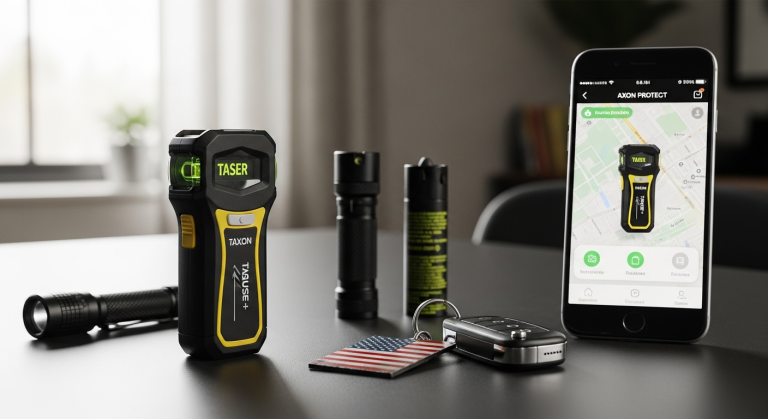
More than 99% of law enforcement agencies in the United States rely on conducted electrical weapons for threat management—and the TASER X2 Professional Series dominates that market for one compelling reason: it works when lives depend on it. The difference between life and death often comes down to equipment reliability, and professionals have voted with their trust.
The TASER X2 isn't your average civilian self-defense gadget. Built by Axon (formerly TASER International), this conducted electrical weapon represents the convergence of military-tested reliability, law enforcement expertise, and cutting-edge neuromuscular incapacitation technology. What separates it from consumer-grade alternatives is its unwavering commitment to delivering consistent, predictable results in high-stress situations where hesitation or failure isn't an option.
Learn more about the TASER X2 Professional Series and secure your personal protection today.
Engineering Excellence: What Sets the TASER X2 Apart in Professional-Grade Design
The TASER X2 operates under a different standard than most civilian self-defense products. It's engineered to duty-grade specifications, meaning it must survive conditions that would destroy lesser equipment. Law enforcement and military applications demand reliability that transcends casual use scenarios—the stakes require nothing less than absolute dependability.
Duty-Grade Construction for Uncompromising Performance
The X2's high-impact polymer casing isn't chosen for cost reasons; it's selected because it withstands harsh field conditions and repeated use without degradation. This material specification ensures the device maintains structural integrity whether it's deployed in extreme heat, freezing cold, or wet environments. The casing absorbs impact stress that would crack cheaper plastics, preserving the critical internal electronics that drive the incapacitation mechanism.
Precision Engineering Across Temperature Extremes
Consistency separates professional equipment from amateur alternatives. The X2 functions reliably across a wide temperature spectrum because its internal components are engineered with precision tolerances. Electrical circuits don't drift in performance as conditions change. Battery output remains stable. Cartridge reliability doesn't fluctuate based on weather conditions. This engineering principle sounds simple until you realize most consumer-grade devices fail under such performance demands.
Modular Design Philosophy for Long-Term Reliability
The X2 embraces a maintenance-forward philosophy. Components are accessible and replaceable without requiring complete unit replacement. Battery cartridges swap out seamlessly. The modular approach extends equipment lifespan and reduces the total cost of ownership—a consideration law enforcement budgets factor into purchasing decisions heavily.
The Dual-Shot Advantage: Why Two Cartridges Change Everything in Dynamic Encounters
Single-shot systems represent a fundamental limitation that dual-cartridge architecture eliminates. The X2 carries two independent cartridges, each fully capable of delivering neuromuscular incapacitation without requiring reloading between shots. This architectural decision transforms tactical options in real-world situations.
Independent Cartridge Architecture for Sequential Deployment
Each cartridge operates independently, allowing the user to deploy the first cartridge and, if circumstances require, immediately deploy the second without any mechanical reloading sequence. This means the time between shots measured in seconds with traditional systems compresses to milliseconds with the X2. In dynamic encounters where threats escalate rapidly, this capability matters enormously.
Critical Backup When First Deployment Proves Ineffective
Threat scenarios don't always unfold predictably. Probe placement may be suboptimal. Clothing might interfere with electrical contact. Distance calculations might be off. The dual-shot system provides a safety net for these real-world complications. Rather than being forced to retreat or transition to another defensive tool, users retain the option to adjust and try again immediately. This backup capability represents the difference between controlled resolution and loss of control.
Improved Probe Placement Through Tactical Adjustments
The first shot provides critical information about threat positioning and response. Based on that feedback, the second shot can be adjusted for better probe placement and improved muscle group engagement. This tactical advantage is exclusive to dual-shot systems and explains why professionals prefer them.
Psychological Advantage of Knowing Backup is Available
Awareness of the second cartridge fundamentally changes decision-making under stress. Users can commit to defensive action with greater confidence because they know they're not betting everything on a single deployment. This psychological foundation supports clearer thinking during high-stress moments when cognitive resources are severely taxed.
Neuromuscular Incapacitation Technology Explained: How the X2 Stops Threats
The X2 achieves incapacitation through neuromuscular incapacitation (NMI), a physiological mechanism distinct from pain-based compliance or injury. This technology overrides conscious resistance by directly disrupting the nervous system's ability to command voluntary muscle movement.
NMI Mechanism and Voluntary Muscle Control
NMI works by targeting the neuromuscular junction—the biological interface where nerves communicate with muscles. The electrical stimulation overrides normal neural signaling, rendering muscles temporarily unresponsive to voluntary commands. A person experiencing NMI loses the ability to control their movements regardless of pain tolerance, training, or mental resolve. This distinction matters profoundly because pain-based systems can fail against determined individuals, while NMI functions as a physiological override.
Probe-Based Electrical Output and Muscle Engagement
The X2 deploys two probes that establish contact with the target's body, creating a circuit for electrical stimulation. The probe design and spacing target major muscle groups—particularly skeletal muscles responsible for gross motor control. Proper probe placement ensures comprehensive neuromuscular engagement, maximizing incapacitation effectiveness. The electrical parameters are calibrated to achieve NMI without causing tissue damage or dangerous cardiac effects.
Temporary Incapacitation Duration and Safe Resolution
NMI produces temporary incapacitation lasting typically 30 seconds from the time electrical stimulation stops. This window provides sufficient time for safe apprehension, de-escalation, or escape depending on the specific scenario. The temporary nature of the incapacitation distinguishes it from lethal force—the threat is neutralized without permanent harm, and the individual recovers completely once stimulation ceases.
Muscle Engagement Principles Beyond Resistance
The effectiveness of NMI transcends willpower or physical conditioning. Subjects cannot overcome neuromuscular incapacitation through pain tolerance or mental fortitude because the mechanism operates at the physiological rather than psychological level. This fundamental principle explains why law enforcement agencies worldwide standardized on CEW technology and why the X2's proven NMI delivery earns professional trust.
Taking Command of Your Personal Security Strategy
The TASER X2 Professional Series represents a deliberate choice—one that says you're unwilling to compromise on reliability when your safety hangs in the balance. This isn't a casual self-defense purchase; it's an investment in proven, battle-tested technology that law enforcement and military professionals depend on when lives are on the line.
The dual-shot capability eliminates the margin for error that single-cartridge systems leave you with, while the integrated targeting systems and warning arc deterrent give you multiple tactical options before ever deploying lethal force. The advanced laser sights and LED flashlight ensure accurate probe placement even in low-light conditions, while the warning arc provides a de-escalation tool that often resolves situations without physical engagement. The Central Information Display keeps you informed about battery status and system readiness, and the duty-grade construction promises longevity through years of reliable service.
Yes, the $1,770 price tag represents a significant investment. However, when you factor in the engineering excellence, the consistency of neuromuscular incapacitation, and the peace of mind that comes from carrying the same device trusted by professionals worldwide, the cost becomes context. You're not purchasing a gadget; you're acquiring equipment that closes the gap between consumer-grade self-defense and professional-grade protection.
Before committing to the X2, verify your local regulations regarding conducted electrical weapons. Laws vary significantly by jurisdiction, and some areas restrict CEW ownership entirely. Complete proper training with your device, understanding how it functions, how to maintain it, and how to deploy it effectively. Know your legal obligations in your jurisdiction and the liability considerations surrounding defensive tool use.
Once you've cleared those hurdles and made the commitment, you'll be carrying one of the most formidable non-lethal incapacitation tools available to civilians—equipment engineered to the same standards professionals trust with their lives.