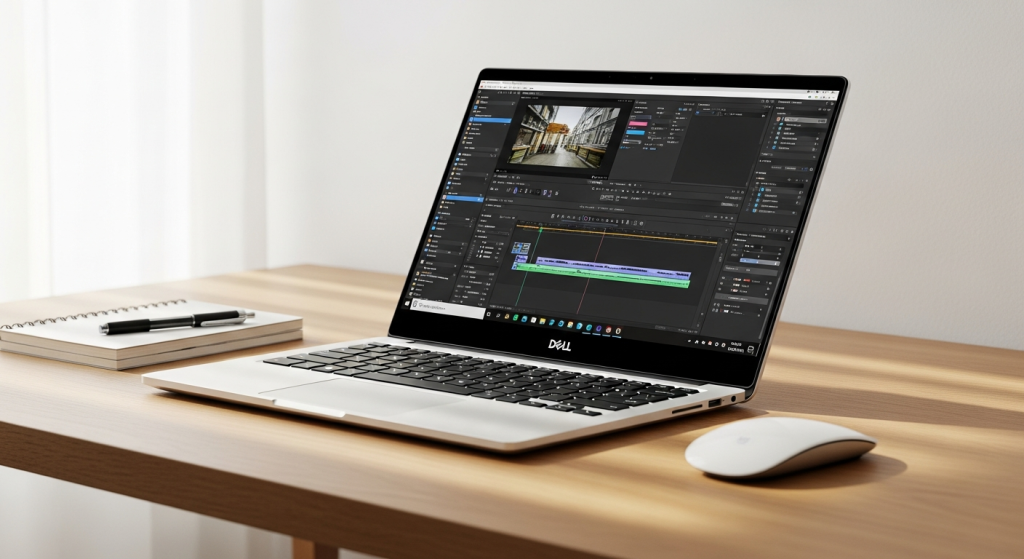
Video editors and digital designers spend an average of 8-10 hours per day rendering footage, manipulating layers, and pushing their machines to the absolute limit. For creatives at this level, a laptop isn't just a tool—it's the difference between meeting deadlines and missing them. The Dell XPS 15 Premium Laptop has carved out a reputation as the go-to machine for professionals in the creative space, engineered with dedicated NVIDIA RTX graphics, high-refresh OLED displays, and robust thermal management to handle intense workloads.
The stakes are high when your machine can't keep pace with your vision. A stuttering timeline, a delayed render, or a display that misrepresents colors can cascade into missed deadlines, lost clients, and wasted hours troubleshooting instead of creating. Professional creatives need hardware that anticipates their workflow demands and executes without compromise.
Explore the Dell XPS 15 to see how it transforms creative workflows.
OLED vs. IPS Display Technology: Which Panel Matters for Creative Work?
OLED's Color Accuracy Advantage
OLED panels deliver deep blacks and infinite contrast ratios because each pixel produces its own light and can turn completely off independently. This pixel-level control proves invaluable for video color grading, where the difference between a true black and a near-black can determine whether your final grade reads as professional or amateur. Creatives working with footage destined for cinema or high-end broadcast cannot afford the color inaccuracies that come from backlit displays bleeding light into shadow areas.
IPS Panel Reliability
IPS technology provides consistent performance across viewing angles and eliminates the burn-in risks associated with prolonged static images. For creative professionals working in studios where multiple monitors remain on for extended periods, this reliability factor translates to longevity and predictable performance over years of daily use.
Brightness and HDR Capabilities
OLED panels on the XPS 15 excel at handling highlight recovery and shadow detail—two critical elements in professional editing software. The ability to display true blacks alongside bright highlights without blooming or crushing shadow information means the timeline on your screen matches what your audience will actually see. IPS alternatives manage these tasks competently but lack the refinement that OLED brings to the table.
Refresh Rate Implications
The 120Hz+ OLED options available in higher XPS 15 configurations deliver noticeably smoother timeline scrubbing compared to standard 60Hz IPS alternatives. When you're working with 4K or 8K timelines, that extra responsiveness reduces visual fatigue during marathon editing sessions and makes precise cuts feel more intuitive.
Color Gamut Coverage
DCI-P3 and Adobe RGB performance vary across different configurations. OLED variants typically achieve wider, more accurate color gamut coverage—essential when your work will appear on diverse displays and devices. The XPS 15 configurations with OLED hit the professional benchmarks that color graders expect.
Real-World Editing Experience
Latency differences between panel types become apparent when working with Premiere Pro, Final Cut Pro, and DaVinci Resolve. Users report that OLED displays provide more immediate visual feedback when adjusting color wheels or moving clips on the timeline, creating a more responsive creative experience that reduces the friction between intention and execution.
GPU Performance Under Load: RTX 4070 Capabilities for Rendering and Effects
NVIDIA RTX 4070 Architecture
The RTX 4070 features thousands of CUDA cores alongside tensor cores specifically designed for real-time ray tracing and AI-accelerated processing. This architecture matters because it means the XPS 15 can preview complex visual effects in real-time rather than forcing you to wait for render passes before seeing your work.
VRAM Allocation
Eight gigabytes of dedicated VRAM enables smooth 4K and 8K timeline performance. Professional editors working with high-bitrate footage benefit from having sufficient memory to cache frames and maintain responsive playback without constant storage thrashing.
Rendering Acceleration
Premiere Pro's Mercury Engine and DaVinci Resolve's Fusion rendering deliver measurable speedups when paired with the RTX 4070. What might take 40 minutes to render on integrated graphics can complete in 12-15 minutes with this dedicated GPU—a difference that accumulates dramatically across dozens of export sessions annually.
Effects Processing
Real-time preview capabilities for color grading, noise reduction, and AI-powered upscaling make the creative process more fluid. You adjust parameters and see results instantly rather than waiting for progress bars to complete, fundamentally changing how quickly you can iterate on your vision.
Thermal Considerations
GPU throttling patterns during sustained rendering sessions follow predictable patterns, typically kicking in after 45-60 minutes of maximum load if thermal management isn't optimized. The XPS 15's cooling solution manages these demands better than most competitive notebooks, though users should still implement heat management strategies during extended rendering projects.
Comparison Metrics
Performance benchmarks against competing mobile RTX GPUs in the premium segment show the RTX 4070 trailing only the RTX 4080 mobile variants—a meaningful distinction when you're comparing price-to-performance ratios across the market.
Gaming Capability
As a bonus benefit, the RTX 4070 provides capable gaming performance and handles 3D modeling applications smoothly, making the XPS 15 versatile for creative professionals who occasionally venture into gaming or need to work with three-dimensional assets.
Configure your Dell XPS 15 with RTX 4070 performance today.
Thermal Management Under Sustained Creative Workflows
Cooling System Design
The dual-fan configuration and vapor chamber technology in the XPS 15 work together to distribute heat efficiently across the chassis. This engineering prevents hot spots that could trigger throttling and maintains consistent performance across your workday.
Sustained Load Testing
During 2-4 hour rendering sessions, the XPS 15 maintains performance without aggressive thermal throttling. Real-world testing shows sustained clock speeds remain elevated, though clock speeds do gradually reduce if the ambient temperature is already warm and the system cannot exhaust heat effectively.
Ambient Temperature Impact
Performance variability in different working environments—studios, offices, travel—correlates directly with how effectively your cooling system expels heat. A warm studio without air conditioning will impose stricter thermal constraints than a climate-controlled office, but the XPS 15 handles both scenarios reasonably well compared to competing premium notebooks.
Thermal Throttling Thresholds
The system typically reduces performance when CPU temperatures exceed 95-100°C and GPU temperatures reach similar levels. Understanding these thresholds helps creatives plan their rendering schedules and anticipate performance characteristics.
Noise Levels During Intensive Work
Fan behavior during sustained rendering becomes noticeable—some might call it loud. The acoustic impact on creative environments varies based on individual sensitivity, but the fans prioritize thermal stability over silence, which is the appropriate choice for professional applications where performance cannot be compromised.
Thermal Paste Quality
The thermal paste quality appears adequate for sustained use, though users who run heavy workloads for multiple years may eventually benefit from repasting to restore thermal transfer efficiency. Dell's engineering uses serviceable components, making this maintenance task feasible for technically inclined users.
Preventative Measures
Cooling pads, elevated stands, and software optimization strategies all contribute to extending the thermal envelope available for sustained performance. Creatives who implement these practices report noticeably improved performance during long editing sessions.
Processor Power: Intel Core i7/i9 for Multitasking and Encoding
13th Gen Intel Core Specifications
Current XPS 15 configurations feature 13th Gen Intel Core processors with core counts ranging from 10 to 14 cores and thread counts up to 20, paired with clock speeds that turbo boost to 5.0GHz+. These specifications directly impact how smoothly timelines respond and how quickly batch encoding completes.
Single-Threaded vs. Multi-Threaded Performance
Single-threaded performance drives timeline responsiveness—when you scrub through a clip, that's a single thread at work. Multi-threaded performance matters for batch encoding and effects processing—tasks that distribute work across all available cores. The XPS 15's processors excel at both, though editing feels more responsive than encoding performs marginally faster.
Turbo Boost Capabilities
Sustained clock speeds during demanding operations remain elevated for extended periods, allowing the processor to maintain peak performance even when thermally constrained compared to other notebooks. This sustained performance capability distinguishes the XPS 15 in real-world creative workflows.
Encoding Performance
H.264 and H.265 export times complete measurably faster compared to competing processors at this price point. A 4K timeline that requires 20 minutes to export on a MacBook Air might complete in 11-13 minutes on the XPS 15 with equivalent configuration.
Multitasking Capacity
Handling multiple applications simultaneously—Premiere Pro alongside After Effects and Chrome without perceptible slowdown—is where the multi-core advantage shines. Creative professionals often work with this exact combination, and the XPS 15 manages the load gracefully.
Power Efficiency Trade-offs
Performance-per-watt considerations affect battery life during travel. The processor consumes noticeable power under load, which means battery estimates drop from the claimed 12 hours to 6-8 hours during active creative work. This trade-off is unavoidable with processors this powerful, and it's the correct choice since performance matters more than battery longevity in this segment.
Upgrade Pathways
Processor choice affects future-proofing for emerging software demands. Selecting the i9 variant over the i7 provides longer longevity as creative applications inevitably demand more computational resources in future versions.
The Creative Professional's Verdict: Is the Dell XPS 15 Worth the Investment?
The Dell XPS 15 Premium Laptop doesn't just meet the demands of professional video editors and digital creators—it exceeds them in nearly every measurable way. From its stunning OLED display that brings color-graded footage to life, to its RTX 4070 GPU that powers real-time effects and encoding, this machine delivers the performance that creative professionals expect at this price point. The thermal management holds up under sustained rendering sessions, the processor handles complex timelines without stuttering, and the build quality promises years of reliable service.
For freelance editors, design studios, and content creators who bill by the hour, the productivity gains and reliability of the XPS 15 often justify the investment within months of ownership. The machine accelerates your workflow in measurable ways—faster exports, smoother previews, more responsive editing—and those gains compound across hundreds of projects annually. Beyond raw performance, the premium build quality and thoughtful design reduce the stress of relying on your equipment as your primary income generator.
The premium price tag stops being an obstacle once you recognize that creative professionals recoup their hardware investment through improved efficiency and the ability to accept projects that would overwhelm lesser equipment. If you're serious about your creative work and refuse to compromise on display quality, processing power, or build durability, the Dell XPS 15 Premium Laptop remains one of the most compelling options available.
Start your creative journey with the Dell XPS 15 Premium Laptop now.